Jonathan Han reviews a bracing debut collection of poems that navigates the translations of a transnational life.
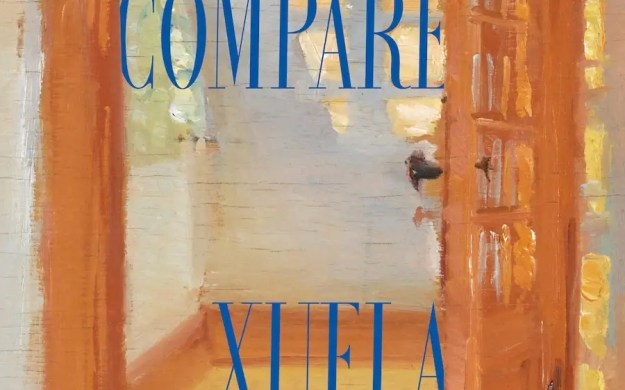
Xuela Zhang, To Compare (Fonograf Editions, 2026), 81pp.
Dedicated to the art of translation, Xuela Zhang’s To Compare is an ambitious debut. A book of poetry split into seven parts, there is no overarching narrative. What holds it all together is how Zhang treats the theme of translation, not just as a vehicle between languages, but as a way of life.
The book begins with two poems, both called “Quarantine.” It is followed by a section titled “To Compare,” consisting of poems all with the same title: “To Compare.” More poems also titled “To Compare” appear towards the end of the book. Although the poems are not sequentially related, the title of “To Compare” invites a reflective approach of tracing the similarities between each one. The first poem of the lot contains an example of Zhang’s careful examination of her craft:
The more you learn,
the more you rely on
abstruse information.
In the analysis,
the elements are
treated as separable
like sound and meaning
in translation.
Zhang’s clarity of voice and her intellectual acuity carry the challenging weight of her thoughts. That being said, her poetry is not entirely abstract. Throughout the book bits and pieces of ordinary life appear, metaphors that seem too real to remain solely figurative. In another poem titled “To Compare,” there are glimpses of a relationship, the challenges of which parallel the challenges of translation:
I consider the meaning
of disappointments
in transnational life.
We might have to relearn
how to stimulate each other.
The world, being small,
competed with all
our untranslatables.
The “transnational life” relates to Zhang’s background – born and raised in China, she studied in the United States and now writes in both English and Chinese. In her consideration, Zhang recognizes translation as a valid mechanism for navigating such a complex life, but concedes that the “untranslatable” remains.
Perhaps one can attribute the untranslatable to why the book does not foreground any examples of Zhang’s own translations. Aside from an epigraph from Zhuangzi translated by Victor H. Mair, the subject of translation is confronted without a solid reference point, effectively excluding any artifact from which the reader might judge Zhang’s or their own conception of translation. That being said, Zhang does cite past translators who bridge the differences between Chinese and English. Ezra Pound, whose book The Cantos is a major text in modernist poetry, serves as a key example:
In Pound’s first
translation of Chinese
(when he did not know
Chinese), he missed much
in the initial poem.
Later, he retranslated.
His emphasis changed
from
“Horses, his horses even, are tired. They were strong.”
to
“(no one feels half of what we know).”
The poem Zhang cites is Ezra Pound’s “Song of the Bowman of Shu,” published first in Cathay (1915). The poem was later published under another title, “Ode 167.” The final line is especially effective, illuminating by way of parentheses the distance between what the translator knows and what she can affect with her translation.
Zhang’s modernist influences are balanced by an incorporation of Chinese classics. The section “Journey to the West” plays on both her own journey westward and the title of the Chinese classic text. In this section, poems are written in the form of an interview with individual characters. The poem “Interview: Pig” contains a representative section:
I plowed
when Master and Monkey
were meditating
I was planting a variety of seeds
when they were imagining
the merging of the three teachings.
People this obsessed
with comparison
rarely arrive at
a preference.
They grow attached to
the translatability of a choice.
How does one translate a choice, when translation is, in itself, a choice? Expand the question to consider how writing is effectively a series of chosen words, and we have a conundrum. Logicians and philosophers may tease out an answer, but for the translator herself, it is the unresolved essence of her craft.
Attachment is a primary cause of suffering in Buddhism, one of the three teachings mentioned above, and one might consider it a mantra when reading To Compare. Stay too long on one turn of phrase, one intellectual puzzle, and risk putting down the entire poem altogether. The book may be challenging for more impatient, indifferent readers. Otherwise, Zhang is, if not a poet’s poet, a translator’s poet.
Jonathan Han is the former editor for Clarion Magazine. His work has been published in Essays in Criticism and New England Review of Books. His chapbook Quinquennial was published by Pen and Anvil Press. He currently lives in Hong Kong. Follow his Substack @jhantheman

