Tim Tim Cheng reviews Theophilus Kwek’s kaleidoscopic poetry of Singapore’s streetscapes.
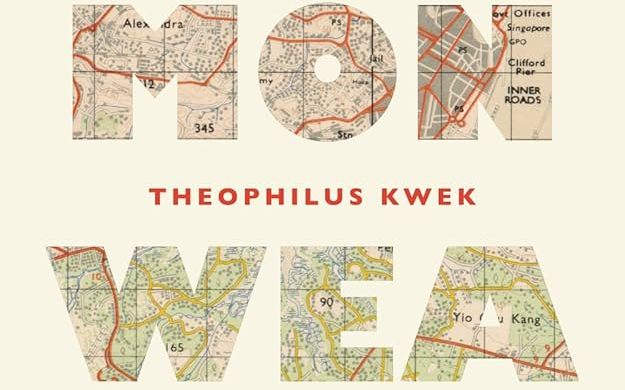
Theophilus Kwek, Commonwealth (Carcanet, 2025), 104pp.
Theophilus Kwek’s Commonwealth reads as a kaleidoscopic series of bedtime stories from and beyond Singapore’s streetscapes. As if recounted by an insistent, erudite grandparent, history unfolds in Kwek’s lyrical verse in praise of lives that cannot be contained by policies or enforced borders.
As a poet from another former British colony, I am curious about how Kwek animates the shared lives across generations creatively, while remaining faithful to the integrity of archival sources. I am intrigued by how Kwek approaches voices that serve more than reportage, that add to or against official records.
In “Part One” of the tripartite collection, Kwek quotes from Lee Kuan Yew’s memoir The Singapore Story (1998) to contextualise a poem titled “Quarantine”. Where Lee sees “political detainees” in “1952”, Kwek sees their imprisonment on an island as a timeless existential and socio-economic condition:
An island is a door
through which a sea is strung, famished lip
of land caught between the country’s teeth,
a spool for the waves. This is how they keep
what must be kapt at bay: on a reef
made fast with a brace of trees, like a fence
fine enough that it stays unseen, or a sieve,
not made to hold but to wear us thin. Once
our fathers came, fleeing death to death,
marooned so the barrenness would cleanse
their bodies’ dread, while not a hand’s breadth
away from their betters ate and slept – exempt
by wealth or whiteness, more often both.
Kwek’s use of assonances and end-rhymes throughout the poem creates a smooth, continuous rhythm. The idea of “fleeing death to death”, rendered in tercets, also alludes to Dante’s hierarchical afterlife: “the ancient spirits disconsolate, / Who cry out each one for the second death” (Inferno).
To know history is to journey through time with renewed eyes. I must confess that when I read the title of “Funan: A Travellers’ Guide”, my first thought was the air-conditioned shopping complex in Singapore. Kwek dislocates the modern reader by citing Asian Geographic, which notes that “Funan” was also a “historical kingdom”. Names renew their meanings:
Cross-legged, they contemplate this odd
reflecting tower, its mudstained sides,
wash its newest names through older tongues:
Phnom. Phù Nam. Fúnán. Funan.
These too come and go, a slower tide.
In “Parable of Feet and Wings,” the desire to settle down, to make home, and/or to draw boundaries links the human and non-human. The use of enjambment reflects a form of co-existence and shifts in perspectives, where insects, geckos, birds, and the human kind engage in small acts of construction and destruction side-by-side. Existence is unstable and fleeting; its remnants, beyond capture:
When the storms come,
a colony has two choices. Lose the walls
and chambers of their mud-slicked nest
to wet decay, or send their best sojourners
out – doves from an ark – that elsewhere
some hardy offshoot of their own might
burrow, thrive. A mystery, if only to our
earthbound eyes, that love by any other
name is flight.
[…]
Stoop close and see. How
fraught and, unburdened by metaphor,
how free: each whip of a tail, each graceful
taking to the air; which ones each season
leave earth behind, and yet are there.
One must acknowledge the limits of excavating history as a late-comer, and the accidents during the process. The collection’s titular poem “Commonwealth” centres a young girl who appears in a photograph of the official opening of Commonwealth Drive. Irregular line breaks create a playfully disruptive rhythm:
She’s ducked beneath
the tape that marks where the road begins,
tape that for now holds the onlookers back
except coming barely to her shoulders it
lets her right through, past all the elbows
to where the action is. Not that you can tell
from the photograph, of course (in some
ways I think you had to be there)
In “Part Two” of Commonwealth, the lightness of touch continues amidst various forms of destruction. Kwek’s poetic voices become increasingly polyphonic, incorporating governmental speeches, Singlish, Chinese, and echoes of historical happenings to recreate noisy neighbourhoods.
“Relocations,” an eight-part poem, partly traces the “1961 Kampong Bukit Ho Swee Fire”, and Kwek’s “family history of the 1968 fire at Bukit Ho Swee”. Every part of the poem takes on a distinct form and tone. In “III. Your Pains Are the Pains of the Government”, the repetition of the title’s phrases deftly turns the saying into a satire, which highlights the distrust and insufficiency of official support in the face of disasters:
And your joy, your happiness are the joy
and happiness of our government. This
is the truth. So let us all face the truth
together. Whoever started this fire
is a heartless person, it was a heartless
person who started this fire. Our government
definitely did not start this fire.
Repetition, the perfect rhyme, recurs in “IV. Zinc”. This results in a sense of childlike wonder: “No one knows how it happens. No one knows how it / happens. No one knows how it happens. It happens / like this: a father builds a pond in the red earth.” This complements the overly stimulated, Chinese-adjacent voice in “VI. Mid Autumn”:
Last time after six you see all the children
go down to the tracks hold their lantern
not like the kind you see today got light
got battery last time is use cellophane
red blue orange wrap around the bamboo
make rabbit make aeroplane make 包青天
like from the TV show yah very colourful
As someone who grew up in social housing, I resonate with Kwek’s description in “Relocations”. It speaks to my childhood fears with retrospective calm: “Something has possessed / the estate, filled it with the sort of quiet / that would wake a kid” (“VIII. Tanglin, halt”). The sense of anticipation, of imminent emergence manifests neatly in “The Swimmers,” a poem dedicated to Kwek’s grandmother: “More than the hop and dive, / this is the moment she trains herself / to look out for: something from nothing, / a shadow under the water’s skin / turning wet and real, emerging”.
In “Chap Lau Chu,” a Housing and Development Board (HDB) estate that got its name from Hokkien, stanzas are arranged as fragments on the page, as windows into a myriad of lives. Multilingual, stubborn voices put a smile on my face, from “not say is very crowded lah”, “soon jor”, to:
Nowadays people grow herb, grow
flower, is different. Last time
Japanese come, all we have is
eng chai to eat! You won’t know one.
Move here, got fruits. Grow papaya
down at the train tracks, lemongrass
outside my front door. After this
not sure whether still can or not.
Can plant? Where to plant? Actually
don’t know. But I say I don’t want.
In “Part Three” of Commonwealth, narratives bounce with more force between the local and international, the past and present, myths and news.
“Morning at the Raffles Hotel,” for instance, takes an alternative look at the aftermath of British colonisation in Singapore. The Raffles Hotel is named after Thomas Raffles, an influential and controversial British colonial officer. The poem, in irregular, unnumbered stanzas, parodies newspaper columns and traces acts of violence throughout different stages of capitalism:
In 1902, the last tiger that was killed in Singapore
was pursued at Raffles Hotel Singapore.
[…]
No-one tells the story –
how once upon a colonial morning
a beast, hunted, haunted instead.
The poem titled “Where They Burn Books” “responds to the artist Wolfram Kastner’s annual act of burning a circle into the Königsplatz lawn, to mark the Nazi book burnings of 10 May 1933”. It juxtaposes with “Allegory of Rain,” the last poem of the collection, which could be read as an acknowledgement of the continuous cycles of repression and resistance: “On another / island which has come to silence they say, / be like water.” Theophilus Kwek’s Commonwealth is a feat of the expansiveness of daily observations, of the necessity of writing amidst a country’s constant reconstruction.
Tim Tim Cheng (she/they) is a poet, translator, editor, and lecturer based between Hong Kong and Glasgow. She wrote The Tattoo Collector (Nine Arches Press, 2024) and Tapping At Glass (VERVE, 2023). With the support of the American Literary Translators Association, they are translating Exposure by Ka Yee Lee.
Find us on Instagram: https://www.instagram.com/hkreviewofbooks/
 HONG KONG REVIEW OF BOOKS 香港書評