Stuart Walton reviews the beautiful yet harrowing autobiographical meditation of Bei Dao.
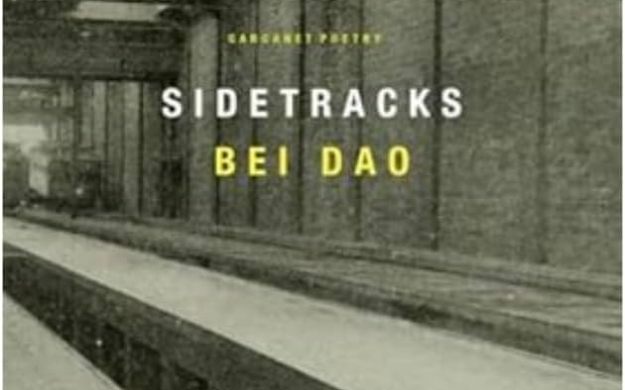
Bei Dao, Sidetracks, trans. Jeffrey Yang (Carcanet, 2024), 170pp.
Bei Dao is the pen name of the poet, memoirist, and essayist Zhao Zhenkai, born in Beijing in 1949, two months before the proclamation of the People’s Republic. His has been one of the emblematic lives of the post-war period, a state of rootlessness improvised between continents and across oceans. More than most, though, Bei Dao’s odyssey has resulted in a transformed return to worlds that once ejected him, an expulsion conducted with the full panoply of senior military officers escorting the unwelcome visitant across airport tarmac to the next flight out, and now the official embrace of an honorary university position. But not all exile is political. It can also include the multifarious ways the body insists on becoming a stranger to itself: “[Y]outh shatters like ancient porcelain,” observes Bei Dao in the third of the thirty-four cantos that comprise this autobiographical meditation, Sidetracks, translated by Jeffrey Yang. In 2012, the poet suffered a stroke, a shock that he compares to being “abducted by the translucent devilfish” [XXXIII].
That things fall apart and the centre cannot hold is old news by now, but this major new work by one of China’s great contemporary voices is an extended refutation of the idea of even looking for a centre in the first place. A continual continental drift has structured Bei Dao’s life, and the moment has come, in his seventy-fifth year, to “let the mountains of lost memories move” [XII]. Sidetracks shuttles back and forth along the sidings and branch-lines into which the poet’s life has been successively diverted, spurning chronology as the lie of linearity that it is. His evocations of other poets – Chinese, Western, Middle Eastern – slip between recollections of treasured acquaintance with the likes of Gary Snyder, Allen Ginsberg, Tomas Tranströmer, Shuntaro Tanikawa, and many others. Voices from the literary ancestry of China are heard intermittently. The Han dynasty medical writer Zhang Zhongjing drops in with healing herbs and stone needles: “the hands of the ancestors feel my pulse” [XXXIII]. The Tang gang’s all here, recumbent on their mountaintop, dreaming at the sparkling night sky, “wine pots empty”, of course.
As the volume unfolds, a mosaic of fragments is assembled. The opening crescendo of the Cultural Revolution is recalled in canto XIV: “wind sweeps through the river of red flags … Young Pioneers swear an oath to the sun / stars beat the military drums / I join the chorus with a stutter”. He was seventeen, ready to build the world anew. Bei Dao worked on rural construction projects in the years that followed, toiling in concrete and metal on sites where the builder’s friend, the radio, blared reprises of “The East is Red” through loudspeakers, but he worked in words, too. He wrote an underground novel, Waves, finishing the first draft of it in a photographic darkroom in 1974.
In the pivotal year of 1989, Bei Dao moved to Berlin, a city unwittingly in the final year of its Cold War bifurcation. Barely had he arrived there than news of events in Beijing filtered through. Now the analogic images of other sections are spurned for bald political statements – “tanks crush historical idealism … guns are the only truth” – before the official line is invoked: “ ‘no one was killed on the square’.” [III]. The preceding canto had held out higher hopes: “the season of change cannot be stopped … the revolution needs a bigger space / so that the same tragedy cannot repeat itself” [II]. For a moment, the momentum seems to lie with the students, as “songs boil the five stars [of the national flag] in the public square”, but then the wailing ambulances and the hurtling flatbed tricycles of the catastrophe supervene. The phone lines between Europe and Beijing are blitzed. Communications are out, in every sense.
Bei Dao’s literary technique is a tautly sustained parataxis, in which the individual pieces build through emotionally suggestive images, declarations, factual fragments, and quotes, but without the connective tissue of standard syntax. In this, it takes its place firmly within the classical Chinese poetic traditions, reaching back through the allusive, sensual odes of the Tang poets, Li Bai and Du Fu, to the Horatian solitude lyrics of the Six Dynasties master, Tao Yuanming. Sidetracks opens with a two-page Prelude of Confucian apostrophes: “Why does history reverse direction / from this moment to antiquity”, “Who among the order of sages / is reading us in the quiet stillness”. Physical pictures are built up in short, simple brushstrokes like Chinese scroll paintings: “the little bridge / and the fishing boat lamp’s hidden bitterness”, but also “the largest public square” and “the closed palace gates”, awaiting the unfolding of history, in whichever direction it occurs and recurs.
One of the sidetracks that Chinese poetics travelled was its co-option by the Beat poets of the North American 1950s. Many passages in this volume recall the attempts at Chinese poetic diction made by Leonard Cohen in the period prior to his recording career. Allen Ginsberg, whom Bei Dao knew well, is commemorated in canto XVIII, in passages that reciprocally instantiate Ginsberg’s own homage to Chinese ways of seeing and saying: “mournful jazz trumpet solo threads through the wind the blade of memory plows Whitman’s open fields”. Tibetan Buddhist meditation practices are invoked as bearers of free poetry, but so are the other ways of altering consciousness: “magic mushrooms are tiny atom bombs of death-wish transcendence”, which is certainly one way of putting it.
This translation from Carcanet is presented as a bilingual edition, the Chinese on the verso (but printed horizontally and reading left to right, to accord with modern practice) and Yang’s poised, meticulous English on the recto throughout. Languages should float side by side like this, running along on adjacent sidetracks from where they can hear each other, each one not the prison-house of the Western philosophical account, but motors through which a relative liberation might be effected. “[A]ll languages circulate against the state of enslavement”, Bei Dao writes [IX]. Another historic upheaval tosses the old borders into the air again: “postwar flags ceaselessly change colors … butterflies flutter above a forgotten line of defense”. Momentarily, the poet becomes Paul Celan, crossing from Bucharest to Vienna in 1947, another metamorphic journey. The new is not merely the strange and the hostile, but might be the latest domicile, as the peripatetic exile hopes, “searching for an unfamiliar city in which I can be reborn”. But he also writes that “the mother tongue has deepened my foreignness”, and elsewhere, “I crouch in the cage of English”, that last, perhaps understandably, during a short writer-in-residence period at the University of Alabama.
Four years after leaving Tuscaloosa, Bei Dao was appointed Professor of Humanities at the Chinese University of Hong Kong, and continues to divide his time between the island and the capital. As the final canto of Sidetracks relates, the global pandemic of recent years brought a sense of exile to even the most rooted of us, a condition in which we learned to shelter indoors in front of our screens, watching “wild beasts steal stealthily into the city” [XXXIV]. Hong Kong isn’t the end of his journey, the poet assures us, in case we entertained visions of a traveller’s well-earned rest. The borders will dissolve again soon enough: “tomorrow has no address”. There is no homecoming.
This beautiful, harrowing, frequently astonishing and unsettling long poem, eleven years in the making, succeeding and deepening a prodigious body of accomplished earlier work, is ample evidence that the Nobel Prize for Bei Dao is surely somewhat overdue.
Stuart Walton is the author, most recently, of Sleepless Nights: The Faults and Failings of Love, as well as studies of chaos and disorder, the five senses, the emotions, and the cultural history of intoxicants. His novel The First Day in Paradise was published in 2016. He lives in southwest England.
Find us on Instagram: https://www.instagram.com/hkreviewofbooks/
 HONG KONG REVIEW OF BOOKS 香港書評