Miguel Antonio N. Lizada reviews Lee Yuri’s provocative, personal short story collection.
Lee Yuri, Broccoli Punch, translated by Amber H.J. Kim (Heloise Press, 2025), 210pp.
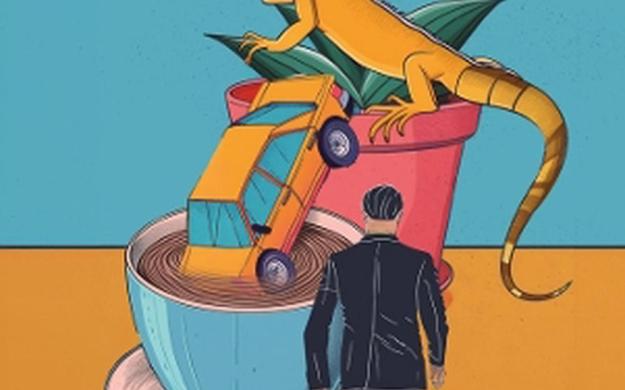
Presented and promoted as a collection of surrealist stories, Lee Yuri’s Broccoli Punch, in bite-sized pieces of anecdotal accounts of the urban everyday, embodies the artistic genre’s tradition of engaging the woes and travails of modern Korean life through the process of defamiliarization and absurdity. Through adept and imaginative strokes, Lee builds a world where the potted ashes of dead relatives grow into fruit-bearing plants that pester and humor their living relatives, where talking iguanas dream of a place of idyllic delight, and in titular story where the winning muscular arm of a champion boxer transforms into a shoot of broccoli.
Utilizing similar techniques employed by prominent surrealist visual artists and writers, Lee renders her engagement through the creative employment of surrealist styles such as exaggeration, juxtaposition, and the use of dreamlike states that phase the realms of the real and the fantastic. When the surrealist veil is lifted, however, what is revealed is the complex web of social relations complicated by the conditions that define modern life: loneliness in a paradoxically hyperconnected world, shifting gender politics, and even mere survival in a world structured through the paradigms of capitalism and commodification.
“Drifting,” for instance, imaginatively examines the complicated process of celebrity culture by domesticizing it as an intimate relationship between Noona, an older and female artist from a prominent family, and Hyung-gyu, a young prodigy whom she discovers busking on the street. As revealed by the title, the story begins with Noona literally drifting and presumably dying at sea after a road accident. It is later revealed that she was on the way to the airport to gift Hyung-gyu with an expensive and personalized piece of Rimowa luggage. As Noona drifts away in the darkness, she remembers her participation in Hyung-gyu’s ascension to the industry that sustains South Korea’s soft power as well as how she had to eventually contend with the emerging star’s fame and developing parasocial relationships with his fans. As Noona continues her drifting thoughts, readers eventually see how her relationship with Hyung-gyu, one that borders on a kind of (s)mothering, is reflective of an inner search for actual, tangible relationships. A surprise and fantastic twist towards the end of the story elevates this otherwise realist meditation on urban loneliness into a statement on the human condition and the restoration of agency in a world structured according to the scripts and strictures that define roles.
The tension between the said and the unsaid, especially with the context of grief, is creatively meditated on in two stories in “Red Fruit” and “Fingernail Shadow.” In “Red Fruit,” the narrator fulfils her dead father’s wishes of planting his ashes in a pot of a small tree. The father eventually takes on a second life as a plant and eventually gets into a relationship with the plant-mother of another person, whom the narrator also gets into a relationship with. In “Fingernail Shadow,” a remarried woman wakes up to find her dead husband in their bedroom. The dead husband explains that he has some unfinished business and can return through a fragment of a fingernail in the bedroom. In both stories, grief is displaced and ornamentalized, presented as palpable, portable, and enduring in the form of easily recognizable objects. Absurd as the stories may seem, they do reflect in many ways the ability of objects to store not just memories, but ghosts of the past: phones and tablets can become books of the dead, potentially storing the voices of people distant or gone and social media pages can turn from albums of adventures to a memorial wall in an instant. In Lee’s world, people from the world of the living are granted the necromantic privilege, for better or worse, to speak back to ornamental residues for a second-chance dialogue to either close wounds or move forward.
The notion of repression is in the titular story, “Broccoli Punch,” where we find the right arm of Won-jun, a famous and multi-awarded boxer, transforming into a shoot of broccoli. In this alternative world, this Kafkaesque transformation is seen as a psychopathological condition of repression: repressed emotions and unacknowledged sentiments alter the body’s physiology – a condition to be sure that remains a fact in the real world. Employing the technique of juxtaposition, that is the placement of two unlikely objects to create contrast and generate a sense of unease, the story meditates on the modern dilemma of having to put up fronts and live up to expectations, of having to maintain a certain sense of legible propriety at the cost of one’s individuality and agency. In this case, the overtly masculine Won-jun, who puts up a testosterone front, is rendered vulnerable but not humiliated by a temporary anatomical change. Towards the end of the story, the cure for such a condition is revealed to be a rather simple yet realistically humane act, one that is doable but otherwise overlooked in a world bound by closed windows, shut doors, and perennial surveillance.
In these stories and the ones that I have not discussed, Lee adopts a tone that strikes a balance between the real and the dreamlike, making the extraordinary appear ordinary in order to highlight the absurdity of the modern everyday. She cleverly follows the surrealist style of automatization, the stream-of-conscious technique where the uncanny and the absurd stream and traffic out, without once violating the reader’s grasp of Lee’s world-building.
The tone of most stories is also comedic and comical but not to the point of being farcical, allowing the reader to gaze into the mirror of the absurd and examine the realities with a light candour that does not compromise criticality. Lee ultimately does this through imaginative articulations of hope expressed through the comic absurd. Most stories end on a happy, hopeful note. Different from, say, the popular Netflix series Black Mirror, which in some degree utilizes the same technique, Broccoli Punch is a humorous, light, yet provocative take that encourages personal engagement rather than stoicism and spiritual capitulation.
As readers are invited to drift with Noona in the dark sea or to walk with Won-jun to the cliff to cure his condition, we are reminded of the transformative power of the surrealist experience. To quote the modernist poet Wallace Stevens as he gazed on the work of Picasso, to partake in the cacophony of the absurd is to listen to a “tune beyond us, yet ourselves.”
Miguel Antonio Lizada is a university lecturer and an artist based in Hong Kong. As an academic he teaches English language and literature courses at The Hang Seng University of Hong Kong. His research interests include Asian popular culture, gender and sexuality, and Asian Literatures in English. He is a writer of poetry and creative non-fiction. He was Fellow for Creative Writing (Non-Fiction and Poetry) in three national writers workshops funded by the National Commission of Culture and the Arts in the Philippines. He was one of the recipients of the Don Carlos Palanca Memorial Awards for Literature (2015), one of the highest literary awards in the Philippines. He is also a theater actor and recently made his Hong Kong debut, playing the lead role in The Bootstrap Theatre Hong Kong’s staging of Fake by Floy Quintos at the Fringe Club .
 HONG KONG REVIEW OF BOOKS 香港書評