
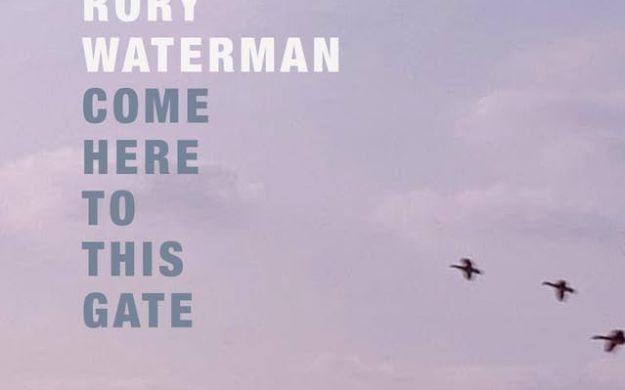
Stuart Walton reviews Rory Waterman’s fourth poetry collection.
Rory Waterman, Come Here to This Gate (Carcanet, 2024), 80pp.
Rory Waterman divides his fourth poetry collection into three divergent sections. “Lincolnshire Folk Tales”, which concludes it, has fun reconstructing some of the county’s traditional legends, including that of the famous Imp that lurks in the interior heights of the Cathedral, into rollicking contemporary ballad form. The middle section, which supplies the volume’s title, is a miscellaneous suite of poems that takes its cue from Ronald Reagan’s famous summons to the Soviet leader Mikhail Gorbachev in 1987, to come to Berlin and dismantle the Cold War’s most visible structure.
However, before we arrive at the geopolitical borders or plunge into regional folklore, there is “All But Forgotten”, a sequence about the gradual decline into alcohol dementia of Waterman’s father, himself a noted poet, Andrew Waterman, who died in 2022. Poetry has always been implicated in commemoration, the elegy being one of its pre-eminent modes since antiquity. It would become one of the primary historiographical resources of the First World War in Europe, but it has also served to set down the affective resonances of personal loss. The American poet Saskia Hamilton turned an unsparing, irresistibly objective eye on her own terminal illness in what would be her last published collection, All Souls, in 2023, and here Waterman commits his father’s final months to literary memory.
Memorialising takes on acute poignancy when memory is precisely what is disappearing in those we love. In “Being Present”, the loops of encumbered communication need nothing more than a sonnet’s length to make the point that our closest interactions depend critically on memories working in tandem. Even the standard conversational forays of the care-home – what did you listen to on the radio? what was there for dinner? – sound like little clinical tests we set for those who have lost their short-term recall and are only intermittently aware that they have lost it. “Tomorrow, / Dad, we’ll do this again for the first time. / It won’t grow old. It won’t have even begun.”
Barely has the tacit invocation of Samuel Beckett’s dramatic tableaux arisen than it quickens into concrete allusion in the very next piece, “Home”: “Stop-gap Clov to your Hamm – // you’d get that, and it wouldn’t help”. From the claustrophobic physicality of Endgame structuring the converse of patient and visitor, the sequence moves to something more akin to the dramatic splinter of Breath for “On Mute”, in which the poet hears his father on the phone struggling to recall anything, to respond at all, over the least forgiving of all communication media. He has forgotten how to hang up, with the result that his son is left listening to his father’s continuing respiration, having prudently muted his own phone, so that the contact is all one way, only one party knowing the connection is still open. This seems to offer a premonitory insight into the separation that will follow, “the silent afterwards, the life to come”.
To a subtle but nonetheless startling degree, these poems largely dispense with the poetic voice. Metaphors have all but dropped out of the sensory and emotional experience of loss, and there is an austere refusal of the elegiac voice, which emerges instead from the sheer accumulation of fact. The inexorable vanishing that memory loss enacts in the sufferer releases a compensating flood of recollections in those who must witness it. These take on the erstwhile function of lyric, and where the poet does permit himself an image, it stands forth all the more starkly amid the prosaic documentary idiom: “Your / silences were trains departing.”
The borders of Part II may be the imagined boundaries between ourselves and our intimates, as much as those that once shut off West from East Berlin, or that still divide the Korean peninsula. Waterman undertook a literary residency in South Korea in 2020, but nothing becomes the poetry quite like the leaving of it, as in the farewell piece “ICN to LHR”, when the return to Heathrow generates only a conventional set of reflections on what Jonathan Raban once called the “twisted nonsense” that jet travel makes of geography.
In the more personal ruminations, the poetry can take on an astringent charge, as in “Gooseberries”, when a woman gathering fruit seems as volatile in the intentness of her foraging as Sylvia Plath among the blackberries. “And we’ll have gooseberry tart – / as tart as her love, its stout fruit / as coarse and hard to sense, when / hidden and wasting in its thicket”. Waterman’s preferred tone, though, is that of the bemused onlooker, reluctant to commit. In “Anniversary”, a flotilla of Chinese lanterns floats off and expires over Lincolnshire’s Belton Park estate, while the poet and his love sit in camping chairs, drinking wine, their differing perceptions producing a final confession: “You wanted nothing else. / I wasn’t ready to take the risk.” The tennis club brings out a Larkinesque instinct for abstention: “I’m sitting out this round, pretending to watch / as the rest of the second team practices for a match / at Ulverthorpe or Culverthorpe or somewhere.”
In the wake of this non-committal voice, the “Folk Tales” come bounding in like comic relief, the weighty air of the principal drama chased off by the spirit of the Greek satyr, or by his distant descendant, the Lincoln Imp, blown out through the “Devil’s Arse” and come to make mischief in the world of airports and tennis clubs and the Cathedral gift-shop. The metrical pulse of these four pieces, their jangling rhyme-schemes, bring an injection of vigour that some might feel unsettles the collection as a whole, but they seem to complete a seasonal affective cycle that begins in wintry abeyance and ends in the green livery and dancing energy of spring.
The volume is bookended with three further poems, the last two of which return us once more to the bittersweetness of memory, the retrospective view in the closing “Envoi” evoking the familiar intimation of an unknown future that was always buried, unsuspected at the time, in the past. Memoration is the abiding theme of this collection, its ambiguous comforts and its destabilising jolts (“Return” in Part II requires the reader to turn the page ninety degrees to encounter it). It is the gate to which we are bidden, the blistered portal to the secret garden, without which love and pain and the whole damn thing would lead nowhere.
Stuart Walton is the author, most recently, of Sleepless Nights: The Faults and Failings of Love, as well as studies of chaos and disorder, the five senses, the emotions, and the cultural history of intoxicants. His novel The First Day in Paradise was published in 2016. He lives in southwest England.
Find us on Instagram: https://www.instagram.com/hkreviewofbooks/
 HONG KONG REVIEW OF BOOKS 香港書評