
Joshua Calladine-Jones muses on Tycho Brahe and Harald Voetmann’s Sublunar
Harald Voetmann, Sublunar (New Directions Publishing, 2023), 128 pp.
History is populated with thoroughly unlikeable people. That’s its fascination. As an adage, this sentiment is surely not lost on Harald Voetmann, whose Sublunar, circumnavigating the life and crimes of Tycho Brahe, uncovers such a gaggle of cads and miscreants that history itself seems to have reached a point not just of population, but overpopulation, of unlikeable residents. This is just one element that makes Sublunar, and incidentally, history as a whole, relatable. Brahe may be less familiar to some readers than Pliny the Elder, antihero of the previous instalment of Voetmann’s trilogy of hubris, Awake. That said, the life of Brahe, not just as a groundbreaking astronomer, but as a man, a liegelord and alleged libertine, is similarly orbited with myths.
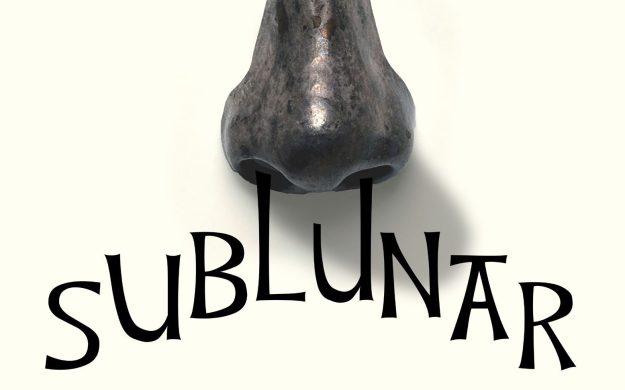
This, though, is an altogether murkier meld. The tonal shift is notable even in the hands of the same translator, J. S. Ottosen, who, as with Awake, seamlessly renders the work into English from the Danish of the original. If the world of Awake was choleric, violent in its obsessions, Sublunar is of a different humour altogether, though there’s still enough choler to go around. Those less familiar with, but who have still heard of Tycho Brahe — as both astronomer and alchemist, duellist and genius, dilettante and courtier, lord and rogue — will probably also be familiar with the whispers and anecdotes of his life and days. This may well be the very thing he is most known for. His scarred forehead, his severed nose, prostheticised with a brass replica, having lost the poor appendage in an ill-starred duel. His unofficial marriage to a commoner, daughter of a Lutheran minister in Knudstrup, of which most of his family disapproved. And his eventual death in exile (during a banquet in Prague, where he had been appointed court astronomer), of an inflamed bladder, having refused politely to leave the table to break the proverbial seal.
All of these actions, comprising so many synechdochic Brahes, huddle alongside his post-Copernican achievements in consistently refuting the immutable cosmology of the era, having observed what he coined a nova stella (or today, supernova) beyond the terrestrial sphere in 1572. Infamy and heresy lend each other arms. Although Brahe could be remembered more for this anti-Aristotelian insistence, than for his supplanted facial feature, it should come as little surprise that his name has fallen out of scientific parlance, and into common gossip, considering his insistence, a belief that seems backwards-looking in contrast to his view of the mutable cosmos, on the Earth as centric to the universe, around which orbits the sun. This speaks only for his relative obscurity in the present, however, which is not to mention his unpopularity, particularly through excessive taxation, in his own time. He is neither Galileo or Copernicus today, and was certainly no benevolent Cyrus in the past. In any case, Brahe clearly makes for a historical character ripe with literary potential. As with Pliny the Elder, a figure with a life no less scandalised with legendary rumour, Voetmann finds in Brahe another vein of weirdness, another famous and ill-famed scientist. The world of Sublunar, though, is marshy. It’s a world more sodden, more earthy, more plutonic, than the dry, Vesuvian planet of Awake. It is, however, no less a sphere of human animals, plodding through the cold and the dirt, no matter how high-minded their brilliance might be.
The spheres of heaven can no longer be called unchanging and eternal. All the stars will fall out like teeth from our gums.
Death itself is never far from the world of Sublunar: it spreads its wingspan across it, with the clouds that obscure the skies above Brahe’s carefully secluded (and exceedingly expensive) observatory. This castle, Brahe’s Uraniborg, is in the end of only architectural appeal (and according to one of the book’s quick diatribes, not even that), the towers being too exposed to the whims of weather and wind for precise cosmic observation. The issue, unavoidable to Brahe, led the astronomer to the construction of yet another observatory, this time partially underground, the castle Stjerneborg, not far from the poorly planned first attempt. Working, as all other stargazers of the time, with no other tool of observation than the naked eye, the parameters of his operation had to be exact. Isolation was paramount, no circle of hangers-on could be tolerated within the confines of the observatory, another reason for his subterranean move. It’s hard not to picture the man glaring up at the heavens for hours on end, in utter seclusion, tears trickling down his strained, unblinking face.
Uraniborg, named for Urania, muse of astronomy. The building seems so legendary a folly that the costly edifice was demolished only two decades after its 1580 completion, by the order of Christian IV of Denmark. Brahe had already abandoned the site three years earlier. Needless to say, the king and the lord were no longer on the best of terms. And so Uraniborg is enshrouded with a sense of this futility, of its eventual obsolescence and destruction, just as it is with the overall presence of death and dying. Throughout Sublunar, death is a state barely removed from life, with its vile excretions and bodily decay, free merely of the burden of shame and soul. Only the thin membrane of ritual, religion, and propriety make any real distinction between the quick and the dead. In the world of Sublunar, that membrane is perforated at best. Death by cold, pants down, voiding the bowels. Death by drowning, washed ashore for a hasty ceremony. Death by alchemical accident, bitten by a furious monkey on the way out.
This dark strain of humour runs through Sublunar, linking it to its precursor like a gnarled umbilical cord dubiously human, originating who-knows-where. As with Awake, the narrative is brought to life in a necromantic way, in which the living monster is reanimated from its once interred body parts: quotes run beneath the surface of journal entries, made by Brahe’s assistants themselves, and their drawings, actually replicated from the Meteorological Diary, at times pepper the margins. This aids the living-dead authenticity that Voetmann works into the text itself:, the book’s epigraph is Voetmann’s own translation from the Latin of Brahe’s first published text, an elegy to his brother, deceased in the womb, published in 1572.
Brahe himself is revealed in a solitary portrait, and the depiction is less than flattering.
I only saw Master Brahe in the seated position, but it is my impression that he is at once fat and hunched, thus manifesting the worst traits of both the noble and the learned. His speech is nasal, even shrill, perhaps as a consequence of his having lost part of his nose in a duel, a section now patched with a leaf made of bent metal and smeared in rosy ointment.
But is this the real Brahe? Is Sublunar merely a pantomime of slander to a great man’s name? The answer cannot be so extreme. The Brahe of Sublunar, for one thing, is hardly the protagonist. Like the Earth of the Tychonic system, the Brahe of Sublunar is the epicentre. He is the hulking, lazy body, unfit for motion (to paraphrase Brahe’s own, De Mundi Aetherei), of the book’s world. In his arrogance, his aloofness, in his static and unmoving presence, around him all else rotates – the hawkers and snake oil salesmen, the alchemists and astrologers. Voetmann eschews history as upheaval spearheaded by unique individuals. Genius doesn’t direct history, it draws history into its orbit. In their greatness, figures the likes of Brahe may come close to this position. They never quite occupy it: no human ever does. Maybe it’s mere stubbornness, married with circumstance, that fixes them in the aether, and their star-map is drawn up in retrospect, in fiction. Voetmann does exactly the latter, and in so doing, draws to mind that Brahe’s stubbornness, as with many of his ilk, wasn’t always forward-thinking. From these tautologies, comes the question Voetmann surely asks: does genius move anything at all? No one would veer too far from contemporary suspicions in suggesting that genius may only move, bulky and cumbersome, on the backs of others.
The sections of the book compiled of accounts by the various maltreated assistants are frequently punctuated by mundane observations of daily meteorology that, in juxtaposition with graphic and dramatic happenings throughout, lend an almost spectral presence to the island, Hven, where Brahe has had his grand observatory erected. Many of them describe a world ante-astral, sheathed in fog and tenebrous obscurity. Bad enough that Brahe has built an observatory useless for anything other than ornament, as liegelord over the island, he couldn’t exactly be described as ahead in the polls. Exacting vassal labour from the peasants is enough to account for that. In one scene, Voetmann has a porpoise that washes ashore mangled by the locals, who torture it mercilessly, slitting off its nose and decorating it to resemble their lord, to whom they have it delivered as a mocking gift.
About half of its snout had been chopped off and a child’s clog heaped with dirt placed across the wound, probably to portray their liege lord’s artificial nose-bit.
Sublunar is divided into sections with different narrators, one of which is addressed in the form of letters from Brahe himself to his brother. It’s worth remembering that his brother is, and always has been, dead. This makes these letters a sort of dear-diary from Brahe to his imagined self, his lost counterpart, as if, like Voetmann, he was also trying to commune with the deceased. The black bile of melancholia oozes from Sublunar like from a bloodletting wound to a leech. Voetmann only spotlights Brahe’s time on the island of Hven, lingering particularly on all its potential folly, and that which is illumined is as a pinprick star on the heavens’ sheet of dark. It’s here that Voetmann gazes into the nothingness like Brahe before him, squinting. The characters of Sublunar are summoned and incarnated, cast into orbit around Brahe, speaking more for his legacy than the man does himself. It is this confluence of fiction, of history, and of the long gone real of the past, that produce the ghostly, if farcical, effect of the novel. Voetmann brings these lost experiences to light from history and invention with measured alchemy, from between inexpressive weather logs and translated fragments, between evidence and conjecture, even if their words, like all others, are doomed in the end to the blackness of darkness, forever. The very necessity to invent them entails this, an irony on Voetmann surely not lost.
Josh Calladine is a literary critic, poet, and writer. Deconstructions, the final part of his Constructions sequence, will be published in 2024. He is currently working on a longer prose project.
 HONG KONG REVIEW OF BOOKS 香港書評